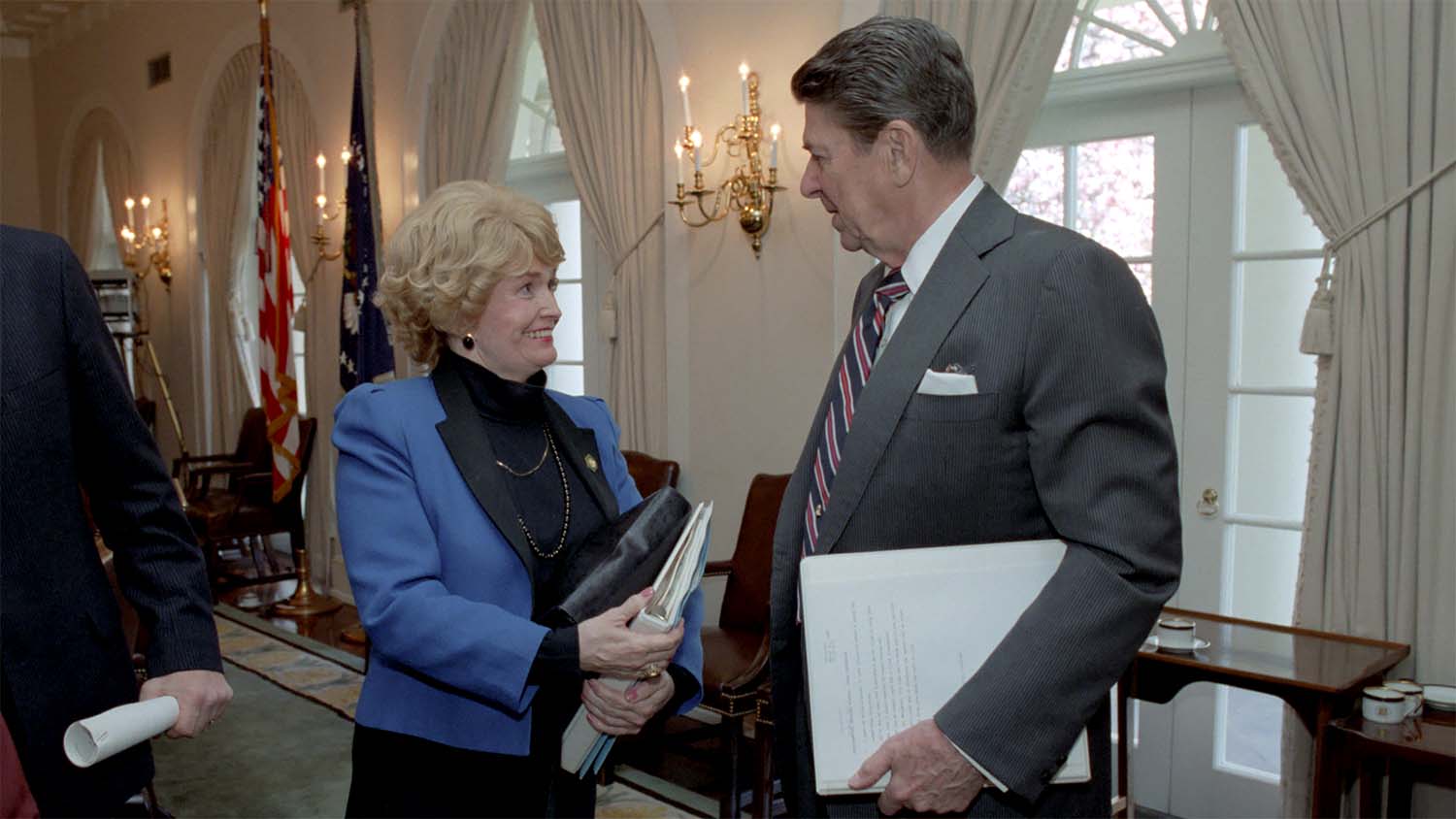
Secretary of Health and Human Services Margaret Heckler with President Ronald Reagan after a Cabinet meeting, March 27, 1985. (White House Photographic Office, public domain)
Public Citizen v. Heckler and the 1987 Interstate Raw Milk Ban
The federal rule that keeps packaged raw milk from crossing state lines, 21 CFR 1240.61, exists because a federal court ordered it. Public Citizen v. Heckler was two lawsuits, filed in 1984 and 1985 by the Health Research Group of Public Citizen against the Secretary of Health and Human Services, Margaret Heckler. The court ordered a ban on interstate sales of all raw milk, certified and noncertified, and declined to order a ban on sales within states.
That second decision left raw milk sales within each state to state law, and today most states allow some form of legal access, as shown on the raw milk law map. The record behind the ban is more mixed than the rule suggests: the department that issued it had denied the same request two years earlier, and FDA said in its own 1987 proposal that it still doubted a ban was needed.
Case summary
| Case detail | Summary |
|---|---|
| Court | U.S. District Court for the District of Columbia |
| Citations | 602 F. Supp. 611 (D.D.C. 1985); 653 F. Supp. 1229 (D.D.C. 1986) |
| Decided | January 14, 1985; December 31, 1986 (judgment amended February 10 and March 11, 1987) |
| Judges | Gerhard A. Gesell (1985); Norma Holloway Johnson (1986) |
| Plaintiffs | Public Citizen and its Health Research Group, Dr. Sidney M. Wolfe, the American Public Health Association, and a California resident |
| Defendant | Margaret Heckler, Secretary of Health and Human Services |
| 1985 holding | The government unreasonably delayed acting on a 1984 petition to ban raw milk |
| 1986 holding | Denying the petition was arbitrary and capricious; FDA must ban interstate sales of all raw milk, certified and noncertified |
| What the court declined | An intrastate ban, and any ruling on the 1974 stay for certified raw milk |
| Result | 21 CFR 1240.61, published August 10, 1987, effective September 9, 1987 |
The 1974 stay for certified raw milk
In October 1973, the Food and Drug Administration finalized milk standards that required fluid milk in interstate commerce to be pasteurized. That rule, and the commissioner who took office three months before it was finalized, are covered in Dr. Alexander “Mack” Schmidt and the 1973 Federal Pasteurization Rule.
Producers of certified raw milk objected. Certified raw milk was produced under the methods and standards of the American Association of Medical Milk Commissions, a private organization whose roots go back to the first certified milk commission in 1893. In the Federal Register of December 5, 1974 (39 FR 42351), FDA stayed the pasteurization requirement for certified raw milk “pending a public hearing on this matter,” and made it final for all other milk. The same order noted that pasteurization could also be required under the Public Health Service Act, the authority the 1987 rule would later rely on.
No hearing on certified raw milk was held until 1984, and the stay remained in effect until 1987. Through those years, certified raw milk could still be sold across state lines. By 1985, FDA knew of only two dairies selling it interstate, and by 1987 only one remained.
The years before the petition
The court opinions and the CDC record show several developments in the decade after the 1974 stay that preceded the petition.
States moved first. Between 1974 and 1982, “a number of states had banned all sales of raw milk,” Judge Gesell wrote. By the time of the 1984 hearing, CDC testimony counted 20 states banning commercial sales to consumers.
Medical groups asked for federal action. In 1980, the American Academy of Pediatrics proposed a federal ban on marketing raw milk.
FDA drafted a ban, and it stalled. According to both court opinions, FDA began drafting a ban on interstate raw milk sales in 1982, and Commissioner Arthur Hull Hayes sent a proposed rule to the Secretary of Health and Human Services in April 1983. He argued that rules under the Public Health Service Act would be more uniform and efficient than a standard of identity proceeding. The proposal was never published. The director of the Centers for Disease Control and the Assistant Secretary for Health, Edward N. Brandt Jr., also supported a ban on interstate sales in 1983 and 1984. Brandt sent the Secretary what he called “further compelling evidence” linking raw milk to a serious form of salmonellosis.
California’s 1983 figures. CDC reported that California identified 123 cases of Salmonella dublin infection in 1983, the most ever reported in a single year, and that 44 percent of patients who answered questions about raw milk reported drinking certified raw milk. The report appeared in the Morbidity and Mortality Weekly Report on April 13, 1984, three days after the petition was filed.
The Health Research Group petitioned a year after the Hayes proposal reached the Secretary. In court, it argued that federal officials had long known of the risks and had not acted on them, and Judge Gesell later noted that the Department had been studying alternatives, such as warning labels, “for nearly two years” without proposing any action.
The petitioners
The petitioner was the Health Research Group, the health division of Public Citizen. Dr. Sidney M. Wolfe, a physician, founded the group with Ralph Nader in 1971 and directed it until 2013. The government’s letters in the raw milk matter were addressed to him.
The plaintiffs in the first suit were Public Citizen, the American Public Health Association and others. The second suit named Public Citizen, Wolfe as director of the Health Research Group, the American Public Health Association, and a California resident. The same attorneys, Eric R. Glitzenstein, William B. Schultz and Alan B. Morrison of the Public Citizen Litigation Group, represented them in both.
The defendant was Margaret Heckler, Secretary of Health and Human Services, which is how the case got its name.
The 1984 petition and hearing
On April 10, 1984, the Health Research Group petitioned the Secretary to “promulgate a regulation banning all sales, interstate and intrastate, of raw (unpasteurized) milk and raw milk products in the United States.”
Secretary Heckler replied on June 6, 1984 that the matter was “under active consideration” and that an informal public hearing would be held. In a second letter on September 4, she wrote that the issue “has been periodically reviewed within the Department for many years without definitive resolution.”
FDA announced the hearing in the Federal Register of August 3, 1984 (49 FR 31065), “in response to a recent petition by the Public Citizen Health Research Group.” It posed two questions: whether consumption of raw milk, including certified raw milk, was a public health concern, and if so, whether requiring pasteurization was the most reasonable regulatory option. The hearing was held on October 11 and 12, 1984.
The record ran to a 330-page transcript and over 300 comments totaling about 4,000 pages. Witnesses against federal regulation argued that many other foods, such as raw meat, also carry harmful microorganisms, that the risk from certified raw milk was low compared with other sources, and that a controlled study should come before any ban. Others spoke for raw milk’s taste and nutrition, and some proposed warning labels instead of a ban. Supporters of a pasteurization requirement came from medicine, public health, state government and the dairy industry. Judge Johnson’s 1986 opinion lists, among others, the American Academy of Pediatrics, the American Veterinary Medical Association, the Association of State and Territorial Health Officials, the National Association of State Departments of Agriculture and the National Conference on Interstate Milk Shipments, along with four dairy industry groups: the National Milk Producers Federation, the Milk Industry Foundation, the National Dairy Council and the Mid-American Dairymen’s Association.
The risk evidence
Most of the evidence behind the ban concerned one germ, Salmonella dublin, in one product, certified raw milk sold in California. Salmonella dublin is a strain that usually lives in cattle. In people it often spreads beyond the gut into the bloodstream, which makes it more dangerous than most Salmonella.
What the record measured
Case counts. CDC’s April 1984 report counted 46 Salmonella dublin cases in California in 1981, 70 in 1982 and 123 in 1983, “the most ever reported in a single year.” Among 1983 patients who answered questions about raw milk, 44 percent reported drinking certified raw milk, compared with 24 percent in 1981 and 1982. Raw milk was “less than 1% of all market milk distributed in California.”
Who got sick. In 1983, 61 percent of patients were 40 or older. At least 24 had cancer, five had AIDS, and others had diabetes or were taking drugs that suppress the immune system. Nearly 80 percent were hospitalized and 26 percent died. Those outcome figures cover all of the year’s Salmonella dublin patients, not only raw milk drinkers.
Contamination of the milk itself. Since 1977, 14 laboratories had made “nearly 200 Salmonella isolates” from certified raw milk, according to CDC. A 1992 California appeals court later found that pathogens had been detected in Alta-Dena’s certified raw milk about 250 times from 1974 to the 1988 trial.
Risk per drinker. CDC assumed that 12,000 gallons of certified raw milk were produced a day and that each user drank one pint daily, which implies about 96,000 regular drinkers. On that basis it estimated 458.3 Salmonella dublin cases per million certified raw milk users in 1983, about 1 in 2,200, against 2.9 per million, about 1 in 345,000, among Californians who did not report drinking raw milk. That is a relative risk of 158. CDC wrote that the association was “about 15 times stronger than the well-accepted association between cigarette smoking and lung cancer.”
Other estimates in the record. An FDA Bureau of Foods review, cited in both court opinions, put the risk for certified raw milk drinkers at 51 times that of pasteurized milk drinkers. A 1986 UCLA School of Public Health study, cited in FDA’s 1987 proposal, found a consistent association from 1980 to 1983, strongest in 1983. The California Department of Health Services reported that half of the state’s 1984 Salmonella dublin cases involved certified raw milk, and that no other risk factor was common among them: 15 percent or fewer had eaten lightly cooked or raw beef.
The opposing side’s statistician. Dr. Joseph Fleiss, a biostatistician who testified at the 1984 hearing on behalf of raw milk proponents, reviewed the same studies and put the odds ratios between 18 and 43. In his view, “Odds ratios of the magnitudes reported, assuming that they hold up under scrutiny, from a low of 18 to a high of 43, suggest in my opinion, a cause-effect relation and not just an association.”
Scotland. FDA’s final rule pointed to Scotland, which banned raw milk sales in August 1983. From 1980 through 1982 Scotland recorded 14 milk-borne Salmonella outbreaks involving more than 1,090 people. In the year after the ban, two small outbreaks involving nine people were reported, involving people who drank raw milk at a local dairy farm.
What the numbers do not show
The record has limits, and the people who opposed the ban raised several of them.
- The per-drinker figure depends on an assumption. CDC’s 1 in 2,200 rests on its estimate of 12,000 gallons a day and one pint per person. More drinkers drinking less would mean a lower individual risk.
- The comparison was not a controlled study. The comparison group was Californians who did not report raw milk, and the studies were reviews of reported cases. Witnesses asked for a case-control study before any ban; FDA replied that, given the size of the association, such a study would be “unnecessary but also ethically questionable.”
- Severe outcomes fell mostly on vulnerable people. The 26 percent death rate reflects a patient group that was older and often seriously ill to begin with.
- The numbers describe one product line. Certified raw milk in the 1980s came almost entirely from one large dairy, and the data say nothing directly about raw milk from other farms or other eras.
- In absolute terms the numbers were small. About 44 of California’s 123 cases in 1983 involved certified raw milk.
Raw milk risk in 1858, 1983 and today
Two other periods are often brought into the raw milk debate: the swill milk era of the 1850s and the present. Each was measured differently, so the figures below are reference points rather than a like-for-like comparison.
| Period | What was measured | Figure | Source |
|---|---|---|---|
| 1857 to 1858, New York City | Infant deaths attributed to swill milk from distillery dairies | “8,000 infants” in one year, in a city of about 814,000 (newspaper estimate) | New York Times, May 13, 1858 |
| 1938, United States | Milk’s share of disease outbreaks from food and water | 25% | FDA, Pasteurized Milk Ordinance |
| 1983, California | Salmonella dublin among certified raw milk drinkers | About 1 in 2,200 a year (CDC estimate), 158 times the rate among non-drinkers | CDC, 1984 |
| 1985 and 2013, United States | National Salmonella Dublin incidence, all sources | 0.081 per 100,000 at the 1985 peak; 0.042 per 100,000 in 2013 | CDC, Emerging Infectious Diseases, 2017 |
| 2005 to 2020, United States | Raw milk outbreaks reported to CDC | 162 outbreaks, 1,696 illnesses, 170 hospitalizations, 2 deaths over 16 years | Stephenson, Coleman and Azzolina, 2024 |
| 2009 to 2014, United States | Outbreak illnesses from unpasteurized cow’s milk and cheese | About 760 illnesses and 22 hospitalizations a year | Costard et al., Emerging Infectious Diseases, 2017 |
| Today, United States | Milk’s share of disease outbreaks from food and water | Less than 1% | FDA, Pasteurized Milk Ordinance |
The swill milk era was a different problem. Its deaths came from milk produced by sick cows kept in distillery stables, adulterated with chalk and dirty water and sold without refrigeration, as described in Will More Raw Milk Drinkers Bring Back the Swill Milk Era? The 1858 figure is a newspaper estimate rather than a count.
The 1980s spike ended. A 2017 CDC study of Salmonella Dublin across the United States from 1968 to 2013 found that the 1980s spike “resulted largely from consumption of raw milk,” particularly from a large California dairy. After a public health investigation halted that dairy’s production and sales, and FDA banned interstate raw milk sales in 1987, “A sharp decline in Salmonella Dublin infections soon followed.” National incidence fell from 0.081 per 100,000 in 1985 to 0.042 in 2013.
Today’s outbreak data are lower, measured differently. From 2005 to 2020, CDC outbreak records linked raw milk to 1,696 illnesses and two deaths over 16 years. Pasteurized milk, consumed far more widely, was linked to 2,111 illnesses and four deaths in the same records. Those figures count only illnesses tied to reported outbreaks, which miss most individual cases, so they are not directly comparable to California’s 1983 count of every reported Salmonella dublin case. Per consumer, outbreak illness from raw milk works out to about 1 in 13,000 to 1 in 15,000 a year.
The relative risk is still high. Because illness from pasteurized milk is so rare, the comparison remains lopsided. Costard and colleagues estimated an outbreak illness rate for unpasteurized milk and cheese about 840 times that of pasteurized products, and the 2017 CDC study found Salmonella Dublin about three times as common in states that allowed raw milk sales or cow shares. Reported illness per raw milk consumer today is far lower than CDC’s 1983 estimate for certified raw milk drinkers, though the two figures count different things. The gap between raw and pasteurized milk has not closed.
The first ruling: unreasonable delay (January 1985)
The Health Research Group sued on September 19, 1984, after the hearing was announced but before it was held. In the court’s description, the only remedy sought was a schedule for the Secretary to decide.
On January 14, 1985, in Public Citizen v. Heckler, 602 F. Supp. 611, Judge Gerhard A. Gesell of the U.S. District Court for the District of Columbia (appointed 1967) granted summary judgment for the plaintiffs. He wrote that the court was “not asked to decide the substantive merits of a ban on raw milk sales. The only issue here is the reasonableness of the agency’s delay.” He found the delay unreasonable and ordered the Secretary to publish, within 60 days, a proposed rule reflecting her decision on the petition.
The March 1985 denial
On January 29, 1985, FDA again recommended that the Secretary require pasteurization of all milk in interstate commerce and sent her a proposed rule. Frank E. Young had been Commissioner of Food and Drugs since August 1984. According to the later court opinion:
The Secretary rejected the FDA’s recommendation and directed the FDA to deny Public Citizen’s petition in its entirety.
By letter of March 15, 1985, the Commissioner of Food and Drugs told Wolfe that the agency would not ban interstate or intrastate sales. The letter acknowledged that raw milk, including certified raw milk, could transmit disease, but gave six reasons for declining a federal ban:
- Most unpasteurized milk was sold only within states.
- Most illness linked to it came from intrastate products.
- There was no reason to think interstate raw milk was riskier than intrastate raw milk.
- On the facts then available, the Department lacked authority to ban intrastate sales.
- Even with such authority, the problem was best handled at the state and local level.
- Interstate sales of certified raw milk were so small that banning them would have minimal effect.
The second ruling: an interstate ban (December 1986)
Public Citizen sued again in 1985, asking the court to compel two things: completion of the pending 1973 rulemaking, and a new rule banning both interstate and intrastate sales.
On December 31, 1986, in Public Citizen v. Heckler, 653 F. Supp. 1229, Judge Norma Holloway Johnson (appointed 1980) ruled partly for each side.
On the 1974 stay, she ruled for the government. Public Citizen had never petitioned the agency to lift the stay, so that claim was not properly before the court.
On the petition, she ruled for Public Citizen and held the denial arbitrary and capricious. “The Secretary’s reason for her decision has no rational connection to the undisputed facts in the record,” the opinion states. The court also pointed to who could act across state lines, using the example of a Nevada resident buying certified raw milk produced in California:
Residents of non-producing states near the producing states do not have access to, and are not represented in, the producing state’s political process.
“Federal regulation is warranted regardless of the absolute volume of certified raw milk sold interstate,” she wrote.
Why the 1986 ruling was unusual
Three parts of the opinion turned on questions that usually favor an agency that declines to act.
Whether the denial could be reviewed at all. The government argued that a decision not to regulate was beyond judicial review, relying on Heckler v. Chaney, a Supreme Court decision issued in 1985 involving the same Secretary. Johnson distinguished it: Chaney concerned a refusal to take enforcement action against particular parties, while “Here the action at issue is not an individual enforcement action, but an agency’s refusal to engage in rulemaking.”
Which documents counted. HHS asked the court to exclude internal memoranda from FDA and CDC officials that supported a ban. The court kept them in the record, finding a showing that the Secretary’s stated reason might be pretext. Saying all raw milk was a known public health risk while refusing to ban it was, in the court’s words, “the essence of arbitrary action.” The court added that it would reach the same result even without those memoranda.
Ordering a rule instead of a remand. Courts that overturn an agency decision usually send it back for the agency to reconsider. Here the court found that “A remand to the agency for further proceedings would serve no purpose and would only add to the delay already encountered,” and directed FDA to issue, and the Secretary to approve, an interstate ban covering both certified and noncertified raw milk and raw milk products. It relied on the rule that a court may compel rulemaking only in “rare and compelling circumstances,” and found them present because the factual question the 1974 stay had left open was now settled.
Sales within states left to the states
Johnson declined to order an intrastate ban:
At this time there is no indication that a rule banning the intrastate sale of raw milk is necessary to effectuate the interstate ban. … Assuming the interstate ban is effective without an intrastate ban, it is up to the individual states to decide on such matters of purely local concern.
She left one door open: “Should it appear that the interstate sale of raw milk continues, it is within HHS’s authority at that time to institute an intrastate ban as well.” No federal intrastate ban has been issued since. In 2012, a federal court in Pennsylvania described the rule’s reach this way: “the regulation of intrastate sale of raw milk is a matter of state law.”
That left raw milk sales within each state to state law, where they remain. The raw milk law timeline tracks state decisions alongside the federal ones, and the United States raw milk law page covers the federal rules in force today.
The deadline: 90 days, then 180
FDA asked the court to clarify its order, pointing out that issuing a final rule immediately would skip the notice and comment required by the Administrative Procedure Act. On February 10, 1987, the court amended its judgment to require a proposed rule under 5 U.S.C. 553 and completion of all rulemaking within 90 days. On March 11, 1987, it extended the deadline to 180 days from February 10, adding: “No further extensions will be granted.”
How the court order became 21 CFR 1240.61
FDA published the proposed rule in the Federal Register of June 11, 1987 (52 FR 22340), signed by Commissioner Frank E. Young and Secretary of Health and Human Services Otis R. Bowen. Because of the court deadline, comments were limited to 30 days. The proposal followed the order but also recorded the agency’s doubts:
FDA continues to question, however, whether a ban is necessary and reasonable in light of the small amount of raw milk and raw milk products in package form in interstate commerce.
It noted that only one producer of certified raw milk remained, and that the firm “also manufactures pasteurized milk and other milk products.” Raw products were about 12 percent of its production, and less than 3 percent of its business was interstate. It also asked for comment on warning labels as an alternative.
The final rule of August 10, 1987 (52 FR 29514) took effect on September 9, 1987. Three comments opposed it, including Stueve’s Natural (formerly Alta-Dena Dairy), then the only certified raw milk producer in the country, and Congressman William E. Dannemeyer. Dannemeyer had a history with the company: in Alta-Dena Dairy v. County of San Diego (1969), his law firm represented Alta-Dena in a challenge to a county order halting its raw milk sales. When the final rule was announced, a Stueve’s official said the company had already halted interstate sales several months earlier, and its attorney, Raymond Novell, estimated that 100,000 consumers used its products, according to UPI. The rule was issued mainly under the communicable disease provisions of the Public Health Service Act (42 U.S.C. 264). In the same issue, FDA ended the 1974 stay for certified raw milk.
The final rule also rejected claims that raw milk is nutritionally superior, concluding that pasteurization does not significantly change milk’s nutritive or immunologic value. For its list of nutrients that pasteurization leaves largely unchanged, it cited a National Dairy Council statement comparing raw and pasteurized milk.
The final rule described the disagreement this way:
The difference in viewpoint between the agency and the Court and comments received has concerned the appropriate way to use Federal resources and the level of government that is best suited to dealing with problems created by raw milk, not the fact that unpasteurized milk and milk products present health risks.
State raw milk laws in 1984, 1987 and today
The case record includes two snapshots of state law, taken by federal officials while the case was under way.
| Year | Source | State law on raw milk sales |
|---|---|---|
| 1984 | CDC testimony cited in the 1985 opinion | Commercial sale to consumers banned in 20 states and allowed in 24; 6 more allowed sales only directly from farmers |
| 1987 | FDA, in the proposed rule | 26 states and the District of Columbia prohibited intrastate sale of unpasteurized milk |
| Today | Raw milk law map | Most states allow some form of legal access, through retail stores, on-farm sales, delivery or herdshares |
FDA wrote in 1987 that the states were “in no way inhibited by Federal law” from prohibiting raw milk sales. Because the rule stops at state lines, the same holds for states that allow them.
What the 1987 rule covers
The rule bars delivering into interstate commerce, or selling after interstate shipment, any milk or milk product in final package form for direct human consumption unless it has been pasteurized or made from pasteurized dairy ingredients. It does not cover:
- sales within a state
- raw milk shipped across state lines to a plant for pasteurization
- products with an alternative to pasteurization set by regulation, such as cheeses cured under 21 CFR Part 133
In the Federal Register of December 4, 1992 (57 FR 57343), FDA added definitions making explicit that “milk products” include products from goats, sheep and water buffalo as well as cows, and that the rule reaches butter, yogurt, kefir, cream, ice cream and cheese where not specifically exempted. FDA described the change as making “explicit that which was implicit in the original rule.”
Challenges to the rule since 1987
Three later federal cases tested the rule from the other direction.
Farm-to-Consumer Legal Defense Fund v. Sebelius (Iowa, 2010 to 2012). Raw milk buyers, a buying club organizer, a farmer and the Farm-to-Consumer Legal Defense Fund challenged the rule, arguing among other things that it violated rights to travel and privacy. In 2010, Judge Mark W. Bennett let the case proceed but paused it to give the plaintiffs time to petition FDA. On March 30, 2012, he dismissed it for lack of standing, relying on an FDA statement of November 1, 2011:
With respect to the interstate sale and distribution of raw milk, the FDA has never taken, nor does it intend to take, enforcement action against an individual who purchased and transported raw milk across state lines solely for his or her own personal consumption.
United States v. Allgyer (Pennsylvania, 2012). After a two-year undercover investigation, FDA sued Daniel Allgyer of Rainbow Acres Farm in Kinzers, Pennsylvania, whose raw milk was ordered online and delivered to drop sites in Maryland and the Washington, DC area. On February 2, 2012, Judge Lawrence F. Stengel granted summary judgment and permanently barred him from shipping raw milk across state lines. The same opinion noted that Allgyer “is not prohibited, under state law, from selling raw milk in Pennsylvania, and his operations are permitted to continue in that vein.”
McAfee v. FDA (Washington, DC, 2021 to 2022). California dairy farmer Mark McAfee and the Farm-to-Consumer Legal Defense Fund petitioned FDA in 2016 to exclude butter from the rule. FDA denied the petition on February 27, 2020. The district court upheld the denial in May 2021, and on June 10, 2022 the D.C. Circuit affirmed in McAfee v. FDA, 36 F.4th 272, holding that the pasteurization rule does not change butter’s statutory definition. The case mirrored Public Citizen v. Heckler: a citizen petition, a denial, and review in the federal courts in Washington. This time the court described its review of a denied petition as “extremely limited and highly deferential,” and the denial stood.
Can raw milk cross state lines today?
Not for sale in final package form for direct human consumption. The 1987 rule is still in force, and Allgyer shows FDA enforcing it against farms that ship across state lines. Individuals are in a different position: FDA has said it has never taken, and does not intend to take, enforcement action against a person who buys raw milk in one state and carries it home to another for personal consumption.
Members of Congress have proposed letting raw milk move between states that each allow it, most recently the Interstate Milk Freedom Act of 2026, introduced as H.R. 7880 on March 9, 2026.
Full timeline
| Date | Event |
|---|---|
| October 10, 1973 | FDA milk standards require pasteurization of fluid milk in interstate commerce (38 FR 27924) |
| December 5, 1974 | FDA stays the requirement for certified raw milk pending a hearing (39 FR 42351) |
| 1980 | American Academy of Pediatrics proposes a federal ban on raw milk marketing |
| April 1983 | Commissioner Hayes sends an unpublished interstate ban proposal to the Secretary |
| April 10, 1984 | Health Research Group petitions for a ban on all raw milk sales |
| April 13, 1984 | CDC reports a record 123 Salmonella dublin cases in California in 1983 |
| August 3, 1984 | FDA announces a public hearing (49 FR 31065) |
| September 19, 1984 | First lawsuit filed |
| October 11 and 12, 1984 | Public hearing held |
| January 14, 1985 | Judge Gesell finds unreasonable delay (602 F. Supp. 611) |
| March 15, 1985 | FDA denies the petition at the Secretary’s direction |
| December 31, 1986 | Judge Johnson orders an interstate ban (653 F. Supp. 1229) |
| February 10 and March 11, 1987 | Deadline set at 90 days, then extended to 180 days |
| June 11, 1987 | Proposed rule published (52 FR 22340) |
| August 10, 1987 | Final rule published (52 FR 29514); 1974 stay ended |
| September 9, 1987 | 21 CFR 1240.61 takes effect |
| December 4, 1992 | FDA defines “milk products” to include goat, sheep and water buffalo milk products, butter and cheese (57 FR 57343) |
| November 1, 2011 | FDA says it does not take enforcement action against individuals carrying raw milk across state lines for personal use |
| February 2, 2012 | Permanent injunction in United States v. Allgyer |
| March 30, 2012 | Farm-to-Consumer Legal Defense Fund v. Sebelius dismissed for lack of standing |
| June 10, 2022 | D.C. Circuit upholds FDA’s denial of the raw butter petition in McAfee v. FDA |
| March 9, 2026 | Interstate Milk Freedom Act introduced (H.R. 7880) |