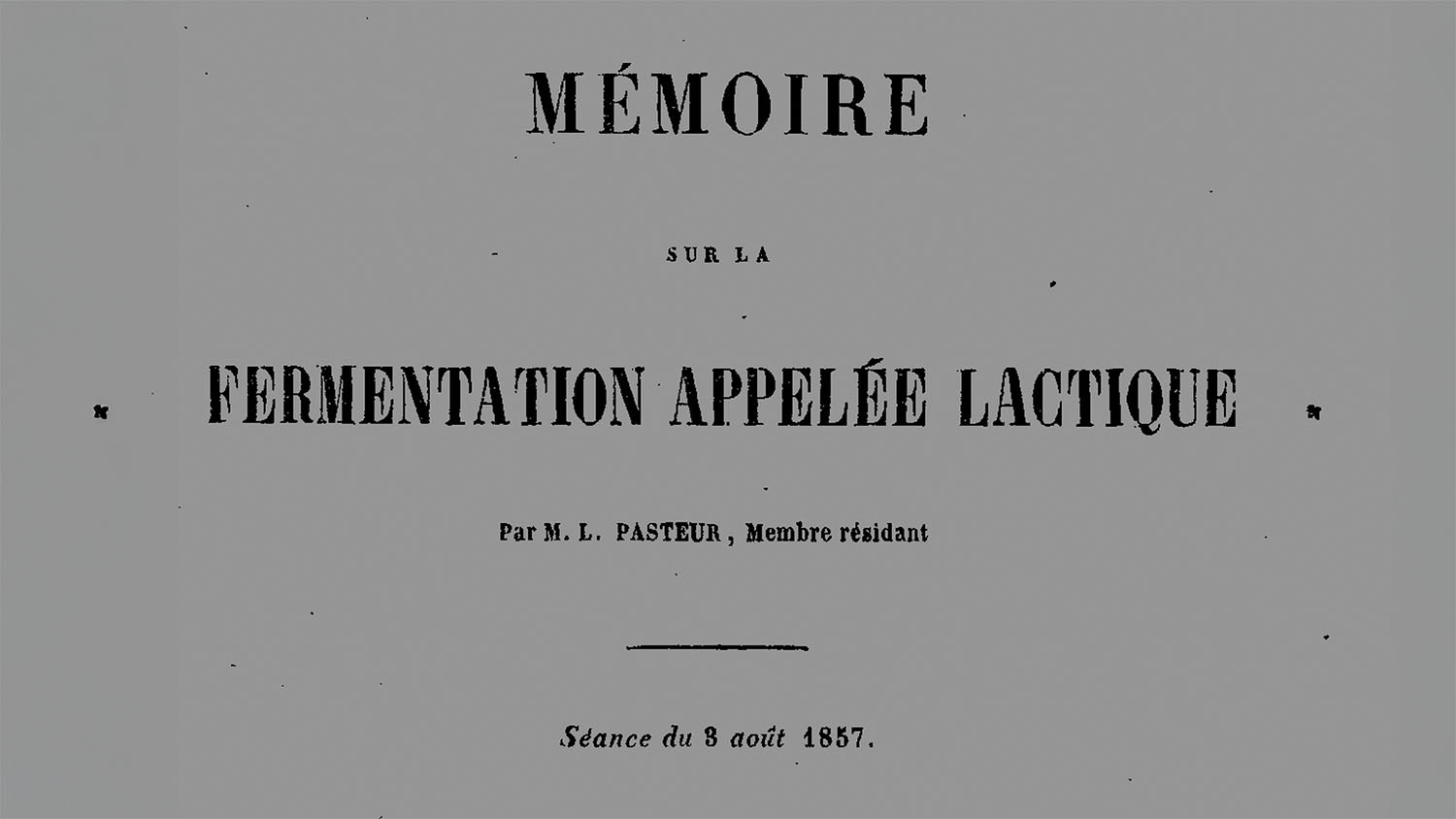
Pasteur read this memoir to the Société des Sciences de Lille on 3 August 1857. Lactic fermentation is the souring of milk, and this was the first fermentation research he wrote up and published.
What Pasteur Wrote About Milk: The 1857 Memoir on Lactic Fermentation
Louis Pasteur came to fermentation through beet alcohol. In the autumn of 1856 a Lille manufacturer named Bigo, the father of one of his students, asked him to find out why the fermentations at his distillery kept failing, and Pasteur’s notebooks have him on the problem that November. By April 1857 he had three investigations running at once: alcoholic, tartaric, and lactic.
He wrote up the lactic one first. Read to the Société des Sciences de Lille on 3 August 1857, it is his first published memoir on fermentation, and lactic fermentation is the souring of milk.
In it he finds the organism that turns milk sour, isolates it, grows it deliberately in a flask, describes it under a microscope, and argues that fermentation is the work of living things rather than chemical decay. It is generally treated as the founding document of microbiology.
He then worked another 38 years, on wine, beer, silkworms, anthrax and rabies, and never proposed heating milk.
Both halves of that are worth holding at once. Pasteur understood milk souring better than anyone alive in 1857, and drew no public health conclusion from it. The proposal to heat milk came thirty years later, from a German chemist who never worked with him.
Where to read Pasteur’s 1857 memoir
The memoir exists in three printings, and they are not identical.
Pasteur read it to the Société des Sciences, de l’Agriculture et des Arts de Lille at the session of 3 August 1857. That version was printed in the society’s Mémoires, second series, volume 5 (1858), pages 13 to 26. The title page identifies him as a membre résidant, a resident member. He was 34, and had been dean of the science faculty at Lille since 1854. He left for Paris that autumn.
He had addressed the same society on alcoholic fermentation earlier that year, at the sessions of 16 April and 1 May 1857, reporting his discovery of succinic acid among the products. He records those in a later footnote as things he communicated, and the succinic acid work reached print afterwards. The lactic memoir is the first fermentation research he wrote up and published, and the editors of his collected works call it son premier mémoire.
A four-page abridgement, prepared by Pasteur himself and labeled Extrait par l’auteur, was read to the Académie des Sciences in Paris on 30 November 1857 and printed in the Comptes rendus, volume 45, pages 913 to 916.
The complete text was reprinted the following year in the Annales de chimie et de physique, third series, volume 52, pages 404 to 418. All three are digitized and free to read at the Bibliothèque nationale de France. Both the full memoir and the author’s extract were later collected in Œuvres de Pasteur, tome II, published by Masson in 1922.
One small detail separates the Lille printing from the Paris reprint. In the avant-propos Pasteur refers back to earlier work he had presented. The Lille text reads dans l’une de mes dernières communications à la Société. The Annales version, headed Lu à l’Académie des Sciences dans sa séance du 30 novembre 1857, reads à l’Académie. He changed his audience when the paper moved to Paris.
Milk is in the memoir from its second page
The memoir opens with a personal preface explaining how a crystallographer came to study fermentation, and then moves into a section headed Historique. Its first sentence is about milk.
L’acide lactique a été découvert par Scheele, en 1780, dans le petit-lait aigri.
Lactic acid was discovered by Scheele, in 1780, in soured whey. Pasteur adds that Scheele’s method for extracting it “would still today be the best one could follow,” and reproduces the procedure in a footnote: reduce the whey to an eighth by evaporation, filter, saturate with lime to precipitate the calcium phosphate.
He then traces the substance through the literature. Braconnot found lactic acid in fermented beet, in boiled beans and peas, in sour water made with baker’s leaven, and finally dans le lait aigri, in soured milk. Pelouze and Gay-Lussac established its composition in 1833. Fremy and Boutron, in 1841, found that casein’s action was halted by the lactic acid it produced, and by neutralizing the liquid periodically with bicarbonate of soda they managed to convert tout le sucre du lait, all of the milk sugar. Pelouze and Gélis improved on it by adding chalk, which holds the medium neutral on its own.
That chalk method is the recipe Pasteur inherits and the one he sets out to explain. Sugar water, chalk, and a nitrogenous material. The nitrogenous material he names first, in both versions of the memoir, is le caséum. Casein. The protein of milk.
The raw materials of the founding paper of microbiology are milk sugar, milk protein, and a phenomenon first identified in soured whey. Milk is the substrate.
What Pasteur found in a lactic fermentation
Chemists at the time believed fermentation was a chemical process, a decomposition that the nitrogenous matter somehow induced in the sugar while itself decaying. Justus von Liebig was the authority for this view. Pasteur says plainly that the explanation is obscure and that nobody knows what the nitrogenous material is doing. Its weight does not change appreciably. It does not become putrid. Yet it is visibly altered.
Then he tells the reader where to look.
Si l’on examine avec attention une fermentation lactique ordinaire, il y a des cas où l’on peut reconnaître au-dessus du dépôt de la craie et de la matière azotée des taches d’une substance grise.
If one examines an ordinary lactic fermentation attentively, there are cases where one can make out, above the deposit of chalk and nitrogenous matter, patches of a gray substance. Sometimes it is stuck to the upper walls of the vessel, carried there by the gas. Under a microscope, he says, an unprepared observer would not distinguish it from disaggregated casein or gluten. Its apparent weight is always very small. Very often it is so mixed into the mass of casein and chalk that there would be no reason to believe it exists at all.
C’est elle néanmoins qui joue le principal rôle.
It is nevertheless this that plays the principal role.
Having named it, he isolates it. He extracts the soluble part of brewer’s yeast in boiling water, filters it carefully, dissolves 50 to 100 grams of sugar per liter, adds chalk, and sows a trace of the gray matter taken from a good ordinary lactic fermentation. He warms it to 30 or 35 degrees and runs a current of carbonic acid through to drive out the air. By the next day, a lively and regular fermentation is underway. The liquid clouds, the chalk disappears, and a deposit grows steadily.
This is a pure culture, prepared and passaged deliberately, in 1857.
The clear yeast-water, he notes, is not a participant in the reaction. Ce liquide limpide, tenant en dissolution une matière azotée, n’est qu’un aliment. This clear liquid, holding a nitrogenous material in solution, is nothing but a food. Its origin hardly matters so long as its nature suits the development of the organized body that grows and settles out. Any nitrogenous decoction will do.
Then he describes the organism:
Prise en masse, elle ressemble tout à fait à de la levure ordinaire égouttée ou pressée. Elle est un peu visqueuse, de couleur grise.
Taken in bulk it looks exactly like ordinary yeast, drained or pressed. Slightly viscous, gray. Under the microscope it consists of small globules or very short segments, isolated or in clumps, forming irregular flocs. The globules are much smaller than those of brewer’s yeast, and when isolated they are vigorously agitated by Brownian motion. Washed by decantation and stirred into plain sugar water, it acidifies the water immediately.
He calls it la levure lactique, the lactic yeast. It is not a yeast. It is what later microbiology would classify among the lactic acid bacteria, the group that includes the organisms in yogurt, in raw milk cheese, in kefir, and in every naturally soured milk on earth. Pasteur described it accurately more than twenty years before anyone had the taxonomy to name it properly.
The sentence that started germ theory
The Lille version closes with a claim the four-page Paris extract leaves out, and it is the reason the memoir matters:
La fermentation s’y montre corrélative de la vie, de l’organisation de globules, non de la mort ou de la putréfaction de ces globules.
Fermentation shows itself to be correlative with life, with the organization of globules, not with the death or putrefaction of those globules. Nor, he adds, is it a phenomenon of mere contact, in which sugar transforms in the ferment’s presence without giving it anything or taking anything from it.
Fermentation is something a living thing does. That sentence is the hinge between chemistry and biology, and everything Pasteur is remembered for follows from it.
Milk souring is the process he was looking at when he wrote it.
After 1857: wine, beer, and never milk
The Paris extract ends with a forward promise:
Dans des communications très prochaines, j’aurai l’honneur de présenter à l’Académie l’application des idées générales et des nouvelles méthodes d’expérimentation de ce travail à d’autres fermentations.
In forthcoming communications, I shall have the honor of presenting to the Academy the application of the general ideas and new experimental methods of this work to other fermentations.
He kept the promise. The memoir on alcoholic fermentation followed within weeks, read to the Académie on 21 December 1857. Then tartaric acid, then butyric, then the work on spontaneous generation. In 1863 Napoleon III asked him to find out why French wine spoiled in transit to Britain, and in 1865 he patented a heat treatment for wine. In 1871 he turned to beer, and in 1876 published Études sur la Bière.
Every one of those is a fermentation problem, approached with the method he built in the lactic memoir. None of them is milk.
Every piece sat in his hands: the organism, the method, a demonstration that gentle heat could stabilize a fermented liquid, and a first-hand description of the microbe that sours milk. He never took the last step, and no surviving document has him suggesting anyone else should.
Who actually proposed heating milk
The proposal to heat milk came from Franz von Soxhlet, a German agricultural chemist in Munich, in an 1886 paper in the Münchener Medizinische Wochenschrift. Soxhlet arrived at it from milk chemistry rather than from fermentation, and his proposal was narrow: seal milk in bottles, heat it, feed it to infants. The science underneath belonged to Pasteur. The application did not.
The industrialization was American and later still. Nathan Straus built a network of pasteurized milk depots across 36 cities beginning in 1893. Abraham Jacobi supplied the clinical argument. The first municipal mandate was lobbied into Chicago in 1908, thirteen years after Pasteur’s death. The word itself was coined by admirers rather than by Pasteur, applied first to wine.
The error persists in live policy documents. A February 2026 memo from Colorado’s Legislative Council Staff, written for lawmakers considering raw milk policy, opened by telling them Pasteur invented pasteurization in 1863 to make milk last longer. He did not, and the 1857 memoir is what makes the correction precise rather than merely contrary.
Raw milk in Pasteur’s France today
France never banned it, and the idea reads as a non-sequitur there. The arrêté of 13 July 2012 defines lait cru as milk not heated above 40°C, and opens three routes to the consumer: sealed bottles filled at the farm and sold direct or through a retail shop, bulk milk packaged in front of the buyer, and automated dispensers. A producer applies to the préfet of their department and the authorization follows an inspection. A dispenser may sit in a different department entirely, provided that préfet receives a copy of the application.
What the text regulates is hygiene, not access. Milk is chilled to between 0 and 4°C immediately after milking, unless it is sold on the farm within two hours of the milking. Dispensers are emptied daily. Producers test their own milk at least twice a month for aerobic organisms, against limits set in the annexes: Listeria monocytogenes below 100 per ml, Salmonella absent in 25 ml, and for cow’s milk no more than 50,000 aerobic organisms per ml. It is a framework built to let raw milk be sold safely, not one that tolerates it.
The same is true in Lille. Two Biocoop organic grocery stores in the city where Pasteur read the memoir, Molinel and Vert’Tige Sébastopol, stock raw milk today. Raw milk sources are listed across France, from Normandie and Bretagne down to Occitanie and Provence, in the cities and in the countryside.
Pasteur worked out why milk goes sour while living in that city. A century and a half later it is still sold there unpasteurized, in shops, to anyone who wants it.
What the memoir establishes
Pasteur studied milk souring in more depth than any person then living. He isolated the organism, cultured it, explained the mechanism, and published the result three times in eighteen months. He worked another 38 years, applied heat to wine and to beer, and never proposed applying it to milk.
Whatever the case for mandatory pasteurization is, it was not made by Pasteur. It was made after he died, by people with different problems and different interests, in a country he never visited. He never pasteurized raw milk, and the paper that put his name on the carton was about wine.
Read the full biography, browse the history of raw milk, or check what the law says where you live on the raw milk laws map.